Tech Insights: AI Agents in Production – From Chatbots to Autonomous Workflows
Introduction:
AI agents have quickly moved from demos and experiments into real production systems. What started as simple chatbots answering FAQs has evolved into agents that can retrieve data, trigger workflows, coordinate tools, and even make decisions within defined boundaries.
But production reality is far less glamorous than early agent demos suggest. Running agents reliably at scale introduces challenges around control, safety, observability, and trust. The real question teams face today is not whether agents are useful, but how autonomous they should be.
This blog looks at how AI agents are actually being used in production, what changes as autonomy increases, and what teams need to get right before trusting agents with real workflows.
What We Really Mean by “AI Agents”?
In practice, an AI agent is not just a model responding to prompts. It is a system that combines:
- a language or reasoning model
- access to tools or APIs
- memory or state
- decision logic
What makes something an agent is its ability to act, not just respond. Even a simple chatbot becomes an agent the moment it can fetch data, update records, or trigger downstream systems.
Understanding this distinction helps teams reason about risk early.
Chatbots Are the Entry Point, Not the End Goal:
Most production agent journeys start with chatbots. They are easy to deploy, familiar to users, and relatively low-risk. Early chatbots answer questions, summarize content, or guide users through workflows.
Over time, teams extend these bots with tool access:
- querying internal systems
- fetching metrics or reports
- initiating predefined actions
At this stage, the agent still operates within a narrow scope. Its role is assistive, and failures are usually recoverable. This makes chatbots a safe proving ground for agent infrastructure.
Tool-Using Agents Change the Risk Profile:
Once agents can invoke tools, the system’s risk profile changes significantly. The agent is no longer just producing text — it is interacting with real systems.
Tool-using agents often:
- read and write data
- trigger workflows
- call internal APIs
- coordinate across services
This is where many teams pause and reassess. Mistakes now have consequences. An incorrect action can propagate through systems faster than a human could react.
At this stage, guardrails become essential.
Autonomy Is a Spectrum, Not a Switch:
A common misconception is that agents are either autonomous or not. In reality, autonomy exists on a spectrum.
Most production systems land somewhere in the middle:
- agents propose actions, humans approve
- agents act within predefined constraints
- agents escalate uncertainty instead of guessing
Full autonomy is rare — and often unnecessary. Teams that treat autonomy as a dial rather than a goal tend to build more reliable systems.
Control and Guardrails Matter More Than Intelligence:
As agents gain responsibility, control mechanisms matter more than raw model capability.
Effective production agents usually include:
- strict permission boundaries
- limited tool access
- explicit action schemas
- fallback paths when confidence is low
These controls ensure that agents fail safely. An agent that refuses to act is far less dangerous than one that acts confidently and incorrectly.
Observability Becomes Non-Negotiable:
Debugging agent behavior is harder than debugging traditional services. Decisions may be influenced by prompts, context, memory, and model behavior — all of which can change over time.
Teams running agents in production invest heavily in observability:
- logging prompts and responses
- tracking tool invocations
- monitoring decision paths
- auditing actions taken
Without this visibility, teams struggle to explain failures or build trust with stakeholders.
Human-in-the-Loop Is Still the Default:
Despite advances in automation, human oversight remains central to production agent systems. Humans provide judgment, context, and accountability — especially for edge cases.
In practice, human-in-the-loop designs:
- reduce catastrophic failures
- improve agent learning through feedback
- increase user trust
- simplify compliance and audits
Agents excel at speed and scale. Humans excel at responsibility. Production systems need both.
Scaling Agents Is an Engineering Problem:
As agent usage grows, new challenges emerge. Performance, cost, and consistency all become harder to manage.
Teams must consider:
- rate limiting and cost controls
- model versioning and rollout strategies
- prompt and tool compatibility over time
- coordination between multiple agents
At scale, agents behave less like chatbots and more like distributed systems — with all the associated complexity.
The Future: Agents as Workflow Components:
The most successful production agents are not standalone entities. They are embedded within larger workflows, handling specific tasks rather than entire processes.
Instead of “one agent that does everything,” teams build:
- specialized agents for narrow roles
- clear handoffs between agents and services
- explicit boundaries around responsibility
This modular approach keeps systems understandable and maintainable as complexity grows.
Conclusion:
AI agents in production are evolving from simple conversational interfaces into powerful workflow components. The real progress lies not in making agents more autonomous, but in making them more reliable, observable, and controlled.
Teams that succeed with agents treat them as systems, not features. They invest in guardrails, visibility, and human oversight, and they scale autonomy cautiously. In doing so, they unlock real value — without surrendering control.
The future of AI agents is not unchecked autonomy, but dependable collaboration between humans and machines.
References:
 Most downloaded free PDF
50 Machine Learning Algorithms Cheatsheet
Blueprints of Intelligence — 50 ML Algorithms decoded
Most downloaded free PDF
50 Machine Learning Algorithms Cheatsheet
Blueprints of Intelligence — 50 ML Algorithms decoded
Enjoyed this post?
Stay in the loop
New posts + weekly digest, straight to your inbox.
Create a free account
- Save posts to your vault
- Like posts & build history
- New-post alerts
Comments
Add Your Comment
Related Posts

Tech Drop: Apple’s First Foldable Sold Out Before It Even Shipped
35
Fintech Internals: Why Payment Systems Are Designed to Be Boring
92
Fintech Engineering: The Engineering Behind Real-Time Fraud Detection
117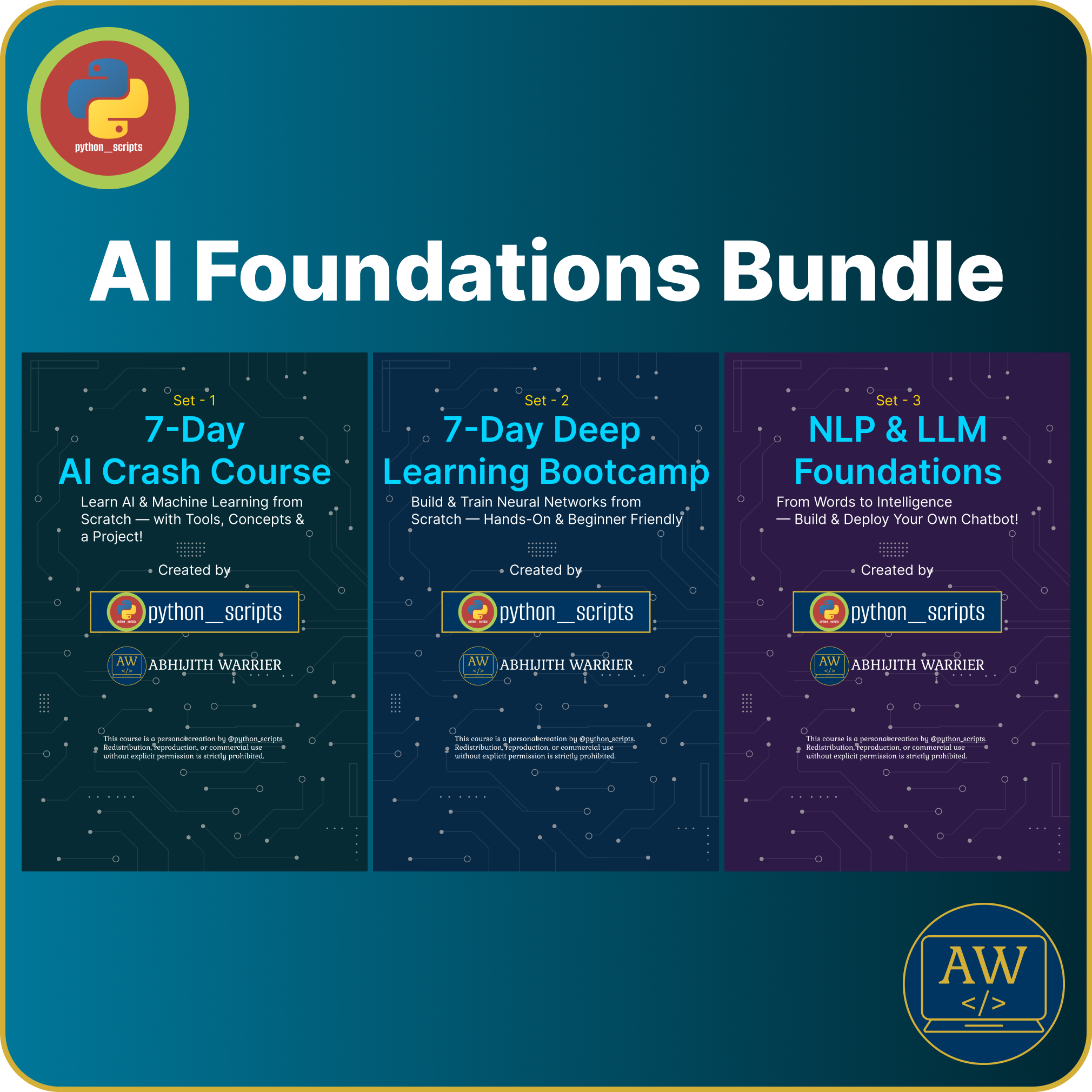
AI Foundations Bundle — From AI Basics to Deep Learning & NLP
Learn AI the right way — from core concepts to deep learning and language models, all in one structured bundle.
Ideal for beginners and developers who want a complete AI roadmap without confusion.
No comments yet. Be the first to comment!