AI Insights: Why Most AI Proof-of-Concepts Never Reach Production?
Introduction:
AI proof-of-concepts are easy to build and surprisingly hard to ship. A demo works, stakeholders get excited, and early results look promising. Then momentum slows down — not because the model stopped working, but because the rest of the system wasn’t ready for it.
Most AI PoCs don’t die due to “bad AI.” They stall because production demands reliability, cost control, governance, and ownership. A proof-of-concept is built to prove possibility. Production requires trust.
This blog explains why that gap is so wide, and what usually breaks first when teams try to cross it.
PoCs Prove Capability, Production Proves Stability:
A PoC answers a simple question: Can the model do the task?
Production asks harder ones: Can it do it consistently? Can we afford it? Can we explain it? Can we support it at 2 AM?
That’s why PoCs feel fast. They skip the inconvenient parts. Production is mostly the inconvenient parts.
Data Stops Being Clean the Moment Real Users Arrive:
PoCs often rely on curated examples. Real usage is messy. Inputs are incomplete, ambiguous, and often shaped by user behaviour you didn’t expect.
Once production traffic begins, performance becomes uneven. The model may still “work,” but it becomes unpredictable across different segments. Teams then realize the problem isn’t just training or prompting — it’s data pipelines, data quality, and data drift.
If your data foundation is shaky, production will expose it immediately.
Latency and Cost Become Product Problems:
In a PoC, a slow response is tolerated. A higher cost per request is ignored because volume is small. Production removes that comfort.
Users feel latency as friction. Product teams feel it as drop-offs. Finance feels it as volatility. And engineering feels it as pressure to optimize something that wasn’t designed for efficiency from the start.
What looked acceptable in testing becomes painful at scale — and the model becomes the scapegoat even when the surrounding design is the issue.
Integration Is Where Most Effort Goes:
The model is usually the easiest part to demo and the hardest part to integrate properly. Real systems need predictable behaviour, safe failure modes, and clear contracts.
This is where PoCs struggle. They are often built around “happy paths.” Production is built around edge cases, partial failures, timeouts, retries, and fallbacks. If those concerns aren’t designed early, teams end up bolting them on later — and that rework is what kills momentum.
Ownership Is Often Missing:
A PoC can survive as a side project. A production system cannot.
Teams need clarity on who owns:
- incident response and monitoring
- prompt/model updates
- evaluation and regression checks
- business approval for risk boundaries
If ownership isn’t defined, the system becomes fragile. People hesitate to change it. Bugs linger. Quality slowly degrades. Eventually the system is “live,” but no one trusts it enough to depend on it.
Evaluation Gets Harder in the Real World:
PoCs often rely on clean metrics and simple validation. Production is messy: correctness varies by context, and mistakes have different severities.
Teams discover that “accuracy” doesn’t translate cleanly to user trust. What matters is whether the system behaves consistently, avoids high-risk errors, and fails in predictable ways. Without a shared definition of what “good” means in production, teams get stuck in endless debates and slow iteration.
Risk and Compliance Arrive Late — and Stop Everything:
PoCs tend to avoid sensitive workflows. Production can’t.
As soon as real customer data, regulated domains, or enterprise requirements enter the picture, teams face privacy, security, retention, auditability, and policy constraints. If these weren’t considered early, the system needs redesign — not minor adjustments.
This is one of the most common reasons a PoC never ships: the risks were invisible until the end.
What Successful Teams Do Differently?
Teams that consistently ship AI systems don’t treat PoCs as disposable demos. They treat them as early versions of real products.
They keep the PoC small, but they still design around reality:
- cost and latency constraints
- failure handling and fallbacks
- monitoring and ownership
- evaluation that reflects real user impact
This doesn’t slow them down. It prevents the “rewrite wall” later.
Conclusion:
Most AI proof-of-concepts don’t fail because the model is weak. They fail because production requires more than capability. It requires reliability, accountability, and predictability — and those don’t come free.
A PoC proves you can do something. Production proves you can do it sustainably. Teams that understand this early build AI systems that reach real users. Teams that don’t stay stuck in permanent experimentation.
References:
Comments
Add Your Comment
Related Posts

AI Insights: When NOT to Use Generative AI in Enterprise Systems
0 24
AI in Production: AI Observability — Monitoring Models, Prompts, and Drift
0 27
AI in Production: AI Failures in Production — What Went Wrong
0 67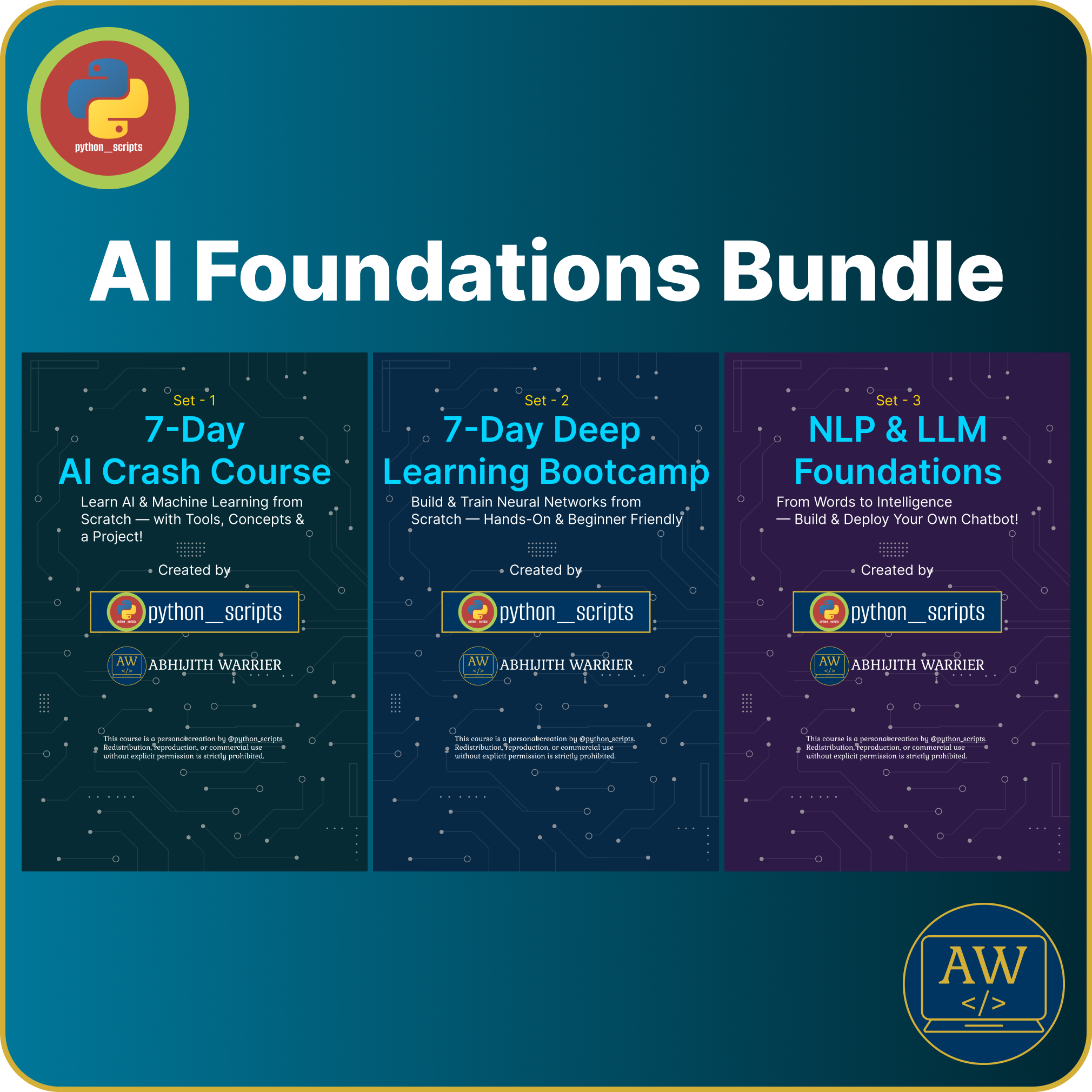
AI Foundations Bundle — From AI Basics to Deep Learning & NLP
Learn AI the right way — from core concepts to deep learning and language models, all in one structured bundle.
Ideal for beginners and developers who want a complete AI roadmap without confusion.
No comments yet. Be the first to comment!