CES 2026: What Actually Mattered (And What It Tells Us About the Next Tech Cycle)?
Introduction:
CES has always been loud. Every year brings larger screens, smarter devices, and ambitious demos. CES 2026 followed that pattern on the surface — but the real story was quieter and far more important.
This year wasn’t defined by a single breakout gadget. Instead, CES 2026 revealed how the technology industry is shifting its priorities. The focus moved away from flashy experiments and toward systems that can survive real-world constraints.
Beneath the noise, CES 2026 showed where AI, hardware, and infrastructure are actually headed next.
AI Is Becoming Hardware-Centric:
One of the strongest themes at CES 2026 was the movement of AI away from purely cloud-based models and into specialised hardware.
Rather than emphasising larger general-purpose models, vendors highlighted purpose-built compute designed for inference, reasoning, and real-time decision-making. The message was clear: scaling intelligence is no longer just about bigger models — it’s about placing compute closer to where decisions happen.
This shift reflects a broader industry realisation. AI systems are increasingly constrained by latency, cost, and energy efficiency. Hardware-aware AI is no longer optional.
Physical AI Is Moving Into Serious Work
CES 2026 made it clear that AI is no longer confined to screens and software interfaces. Robotics and autonomous systems were presented not as novelties, but as early versions of practical tools.
What stood out was not visual spectacle, but context awareness and adaptive behaviour. These systems were positioned for logistics, manufacturing, healthcare, and assisted work — environments where reliability matters more than demos.
Physical AI introduces new challenges: safety, failure handling, and predictable behaviour under uncertainty. CES 2026 showed that the industry is starting to confront those challenges head-on.
Displays Are Becoming Intelligent Interfaces:
Large displays have always been a CES staple, but 2026 reframed their role.
Screens were no longer treated as passive output devices. They became interactive, context-aware surfaces, integrating translation, voice interaction, and adaptive controls directly into the display layer.
This signals a shift toward ambient computing — interfaces that blend into environments rather than demanding constant user attention. Interaction is becoming continuous, subtle, and increasingly invisible.
Edge Computing Took a Quiet Step Forward:
While cloud platforms still dominate AI discussions, CES 2026 reinforced the growing importance of edge computing.
Laptops, embedded systems, automotive platforms, and gaming devices showcased increasingly capable on-device AI. The motivation was practical: reduced latency, better privacy boundaries, and more predictable costs.
Rather than replacing the cloud, CES 2026 highlighted a hybrid future. Intelligence is being distributed across edge and centralised systems based on real operational needs.
Consumer Electronics Reflected Maturity, Not Disruption:
Consumer devices at CES 2026 were refined rather than revolutionary.
Hardware became more efficient, displays more capable, and software more intelligent. AI was present everywhere, but mostly as an enhancement layer rather than a radical redesign.
This kind of incremental progress is a sign of maturity. When technology stabilises, innovation shifts from experimentation to optimisation and integration.
What CES 2026 Did Not Emphasise?
Equally revealing were the narratives that faded into the background.
There was noticeably less focus on speculative metaverse experiences, fully autonomous consumer robots, or sweeping claims about AI replacing human work. Instead, the emphasis moved toward assistive and embedded intelligence.
This signals a more grounded phase of adoption — one shaped by regulation, cost, and real-world deployment constraints.
The Larger Pattern Emerging
Taken together, CES 2026 pointed to a clear industry direction.
AI is becoming:
- more specialized
- more tightly coupled with hardware
- more embedded in physical systems
- more constrained by real-world trade-offs
The industry is moving away from “AI everywhere” and toward intelligence placed intentionally where it delivers value.
This is a quieter shift than previous hype cycles — but it’s far more durable.
Conclusion:
CES 2026 didn’t introduce a single headline-grabbing revolution. Instead, it offered something more useful: clarity.
AI is moving closer to hardware. Intelligence is becoming physical. Interfaces are blending into environments. Edge computing is becoming foundational rather than optional.
CES 2026 marked a transition from possibility-driven innovation to production-oriented reality. For engineers, architects, and builders, that makes it one of the most meaningful CES editions in recent years.
References:
- Business Insider — Major announcements and trends from CES 2026 (🔗 Link)
- The Verge — CES 2026 live coverage and analysis (🔗 Link)
- Yahoo Finance — AI chips and robotics dominated CES 2026 (🔗 Link)
- Tom’s Guide — Best of CES 2026 highlights (🔗 Link)
- Reuters — Arm and the industry’s focus on physical AI (🔗 Link)
 Most downloaded free PDF
50 Machine Learning Algorithms Cheatsheet
Blueprints of Intelligence — 50 ML Algorithms decoded
Most downloaded free PDF
50 Machine Learning Algorithms Cheatsheet
Blueprints of Intelligence — 50 ML Algorithms decoded
Enjoyed this post?
Stay in the loop
New posts + weekly digest, straight to your inbox.
Create a free account
- Save posts to your vault
- Like posts & build history
- New-post alerts
Comments
Add Your Comment
Related Posts
Tech Drop: Apple’s First Foldable Sold Out Before It Even Shipped
35
Fintech Internals: Why Payment Systems Are Designed to Be Boring
92
Fintech Engineering: The Engineering Behind Real-Time Fraud Detection
117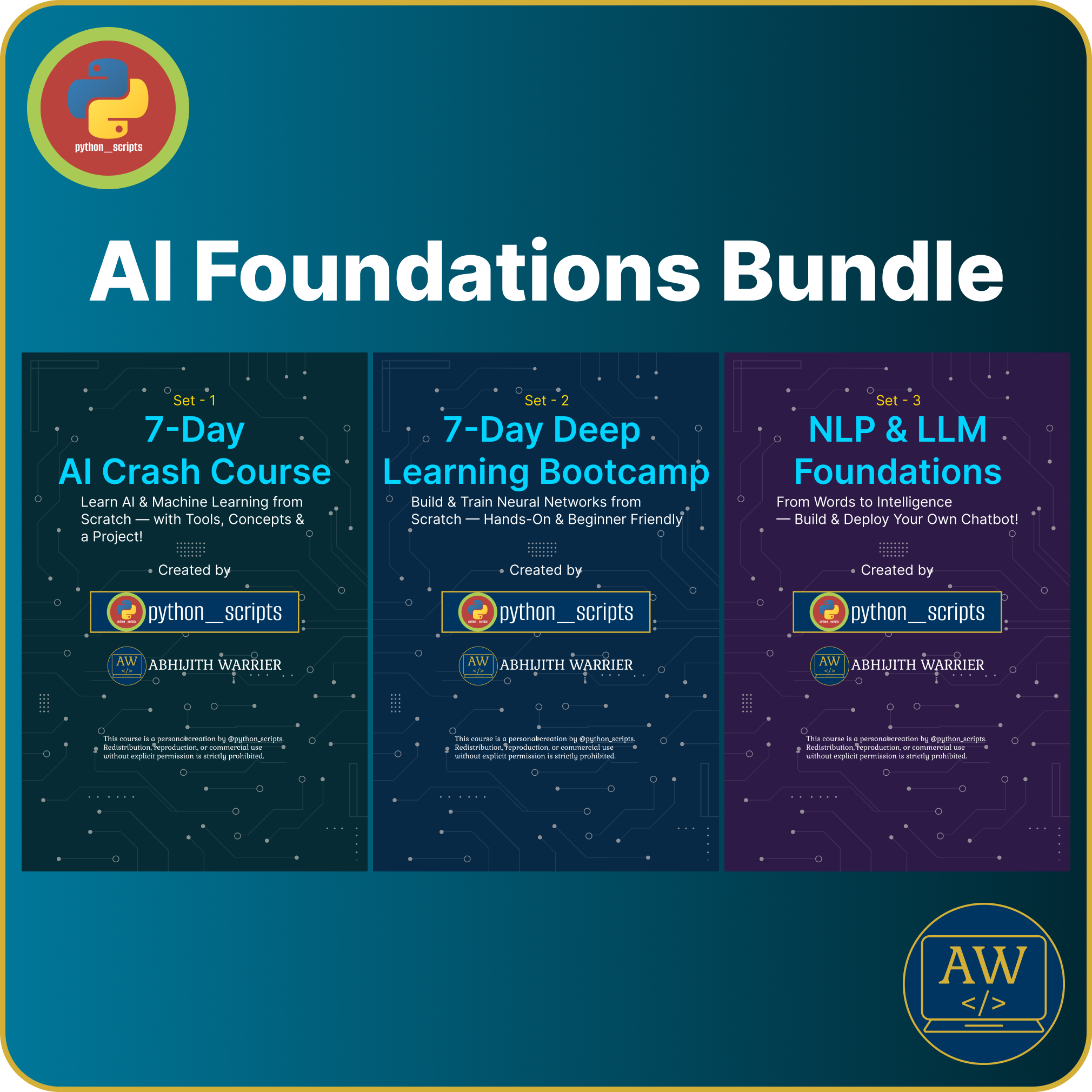
AI Foundations Bundle — From AI Basics to Deep Learning & NLP
Learn AI the right way — from core concepts to deep learning and language models, all in one structured bundle.
Ideal for beginners and developers who want a complete AI roadmap without confusion.
No comments yet. Be the first to comment!